SHIELDS OF FAITH
Christ is King: Crucified
Christ is King: Crucified
Couldn't load pickup availability
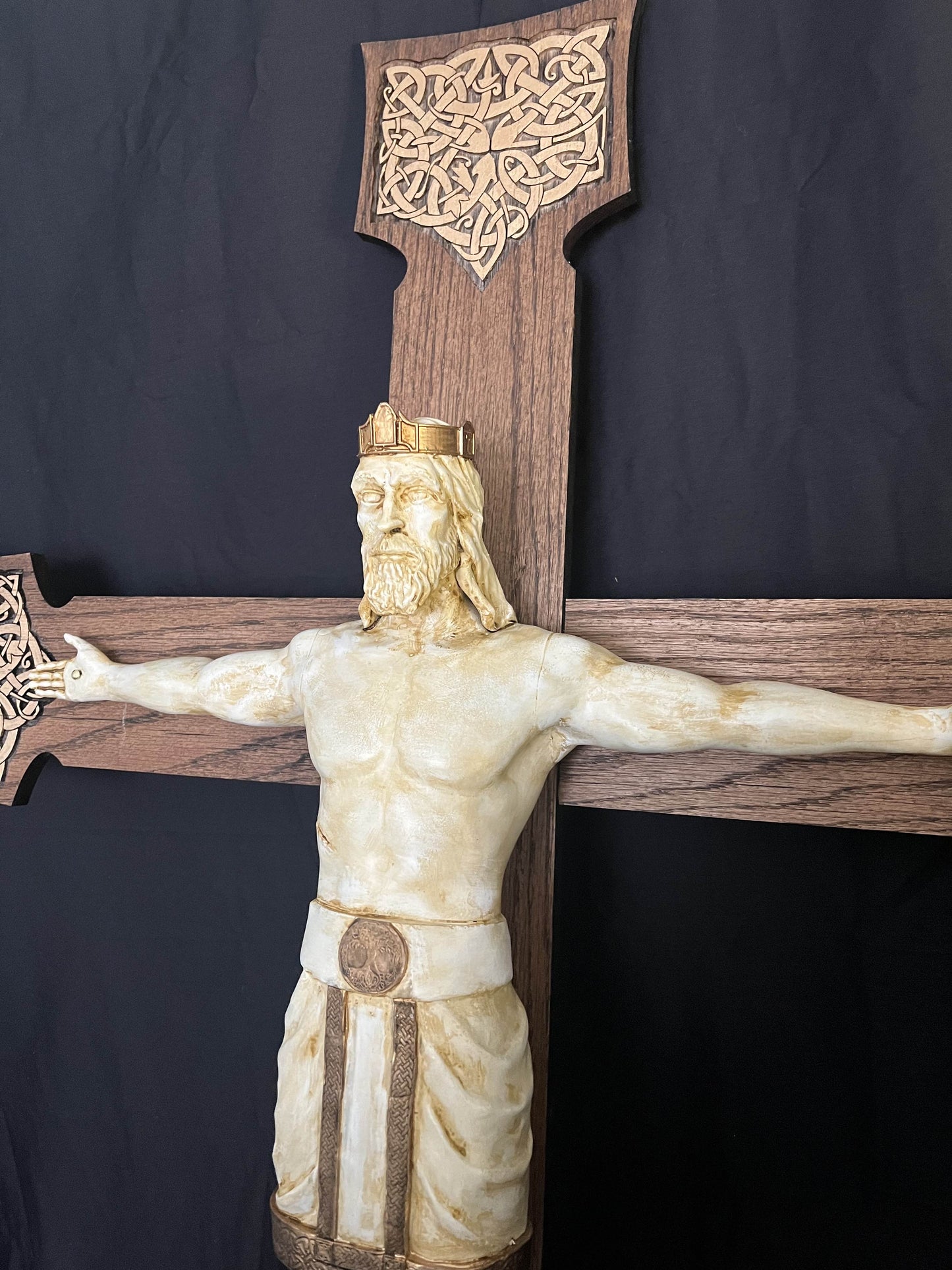
The style of this Crucifix is a deliberate hybrid: the anatomical realism of the Renaissance wedded to
the symbolic language of the Gothic and Romanesque.
The most striking feature is that Christ is self-supported. He does not hang; He stands. This is no
accident of posture but a theological proclamation. His Passion was not imposed upon Him—it was
chosen. Even at the hour of His greatest weakness, He remained fully God, sovereign over His own
death. This visual trope appears as early as the eleventh century, most notably in works such as the
Cross of San Domenico.
Another element rooted in the medieval imagination is Christ’s royal bearing. He wears a crown, and
His garments, though those of the Passion, are adorned with gold. Most telling is the belt buckle,
emblazoned with the two intertwined trees of the Garden of Eden. Calvary is, in essence, Eden
restored. The early Church taught that as mankind was undone by a tree, so by a tree, the Tree of the
Cross, mankind would be saved. This is why Mary bears the title of the New Eve; a truth articulated in
some of the earliest theological works of Church Fathers.
The Cross itself is covered in knotwork inspired by the Book of Kells, lending it the character of a living
tree. It is not merely an instrument of death, but the Tree of Life reborn.
The hands of Christ make the next great proclamation. The right hand is open, the left clenched into a
fist, a direct reference to Scripture:
“And when the Son of Man shall come in His majesty, and all the angels with Him, then shall He sit
upon the throne of His majesty.
And all nations shall be gathered together before Him, and He shall separate them one from another,
as the shepherd separates the sheep from the goats.
And He shall set the sheep on His right hand, but the goats on His left.”
(Matthew 25:31–33)
The open right hand is the Hand of Mercy. The nail wound is visible, for God’s mercy is not free of
suffering. To suffer is to be Christ-like.
The closed left hand is the Hand of Judgment. The nail is hidden. As Scripture warns:
“Depart from Me, you cursed, into the everlasting fire which was prepared for the devil and his
angels.”
(Matthew 25:41)
The face of Christ the Redeemer King is meant to hold both truths at once: invitation and judgment.
This duality must not be forgotten. On the last day, each soul will stand as either a testament to His
perfect mercy or a witness to His justice.
In the medieval mind, Christ was not a passive victim but a warrior king, the Warden of Heaven. The
Crucifixion was understood as a battle, a hidden war fought and won. The exclusive focus on Christ’s
human suffering is a later development in Church tradition. The Cross is indeed about suffering, but it
is also a battle standard, a mark of victory. The suffering is real, but it is glorious.
Only through the Cross does the crown come.